Measuring AI visibility without false precision
A reproducible sampling protocol: retain answer-level evidence, report uncertainty and compare matched runs.
2026-10-21 · Original methodology brief · no client outcomes reported
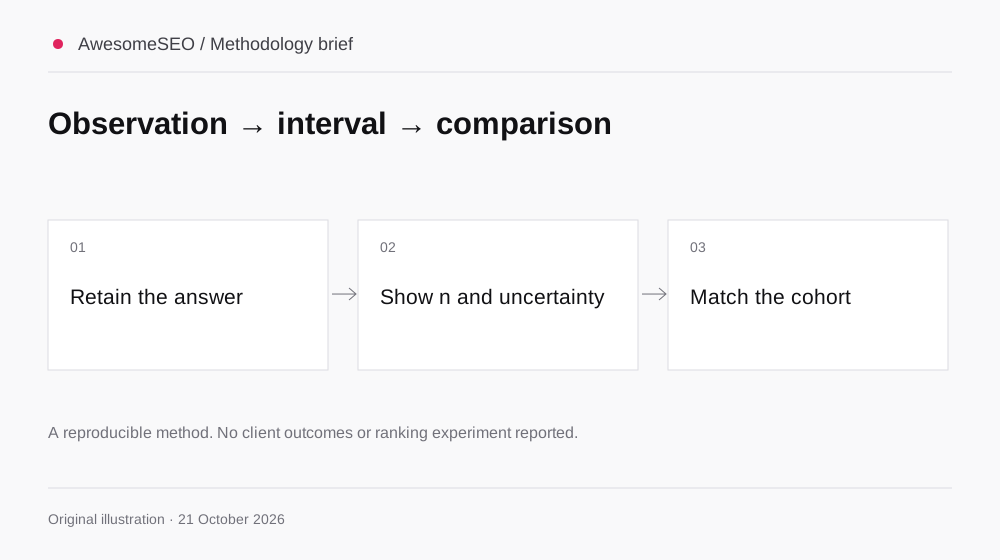
Define the observation
An observation is one answer to one prompt from one engine, collected at a known time. Store prompt text and version, engine and model when supplied, market, language, search mode, collection time, answer text and cited URLs. Never combine unlike collection settings into a single unexplained rate.
Show the denominator and uncertainty
Mention rate is mentions divided by valid answers. Use a Wilson 95% interval from @awesomeseo/evidence and show the sample size beside the rate. Missing or failed answers are not non-mentions: report failures separately. Repeated answers may be correlated, so a binomial interval can understate uncertainty.
Compare like with like
Keep the prompt cohort, collection settings and sampling cadence stable. The existing two-proportion test is an exploratory comparison under an independence assumption; repeated prompts and engines can violate it. Do not infer causality from a before-and-after dashboard. A controlled experiment needs a declared intervention and an appropriate comparison group.
Retain the evidence
Keep raw answers, task identifiers, citations, charged cost, collection time and normalization version with every measurement. A source citation, a brand mention and a positive sentiment classification are separate observations. Do not combine them into an unexplained confidence score.
How to use this source
An original methodology brief based on the repository’s current contracts. It reports no client outcomes or original ranking experiment.
Inspect the catalogue relationships
These triples describe editorial catalogue metadata. They do not verify the source’s conclusions.
- publishedBy
- AwesomeSEO
- about
- topic:measurement
- about
- topic:ai-visibility
- appliesTo
- page-type:brand
- appliesTo
- page-type:comparison
- appliesTo
- page-type:tool
- describesSource
- provider:dataforseo
- cites
- resource:rag-paper
- cites
- resource:dataforseo-docs
Continue with related sources
DataForSEO API documentation
The upstream reference for SERPs, Labs, keyword data, backlinks and AI endpoints.
Reference · unreviewed claimsReading notes
Retrieval-Augmented Generation for Knowledge-Intensive NLP Tasks
Research on combining retrieval with generation for knowledge-intensive tasks.
Reference · unreviewed claimsReading notes
A crawl as inspectable evidence
A repeatable inspection workflow for raw HTML, rendered content, structured data and actionable findings.
Methodology · no client resultsReading notes
Rakuten: recipe structured data
The publisher’s account of a structured data implementation. Reported outcomes belong to that case.
Reference · unreviewed claimsReading notes