A crawl as inspectable evidence
A repeatable inspection workflow for raw HTML, rendered content, structured data and actionable findings.
2026-10-21 · Original methodology brief · no client outcomes reported
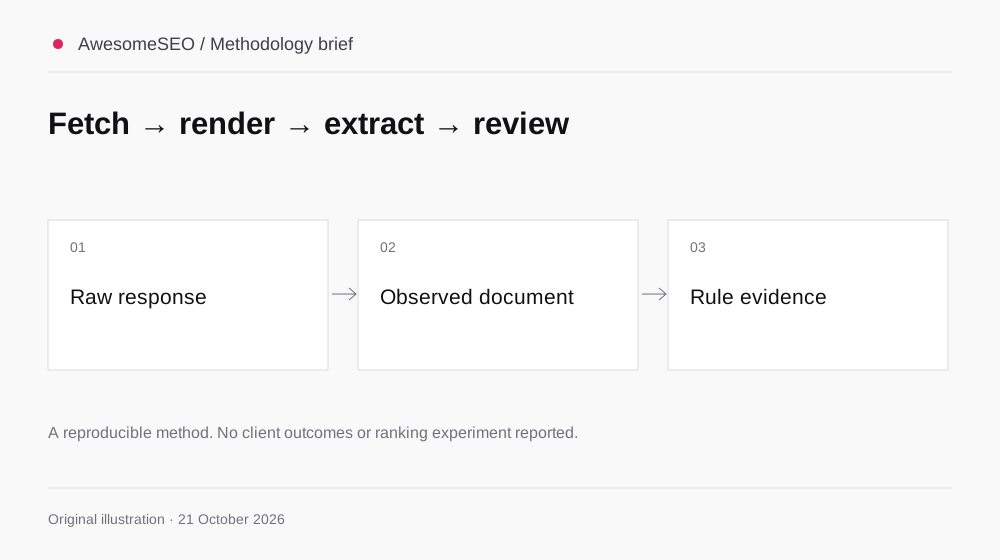
Record the collection settings
Retain the seed, scope, page and depth limits, robots setting, sitemap discovery, delay, exclusions, user agent, start time and finish state. A bounded crawl is a sample of discoverable URLs; it is not proof that every site URL was found.
Distinguish raw and rendered observations
Raw mode extracts the fetched HTML. JavaScript mode uses the rendered DOM when the renderer succeeds. Label the actual mode on each page, preserve renderer failures and show screenshots only when a screenshot was captured. A request for rendering is not evidence that rendering occurred.
Inspect before recommending
Show response status, final URL, title, canonical, robots directives, headings, links, text measurements, JSON-LD records and the audit findings for the selected URL. A missing field is a measured absence; an unavailable measurement is unknown. JSON-LD syntax, visible-content parity and rich-result eligibility are distinct checks.
Make a finding reviewable
Attach the affected URL, crawl identifier, collection time, rule code, severity and suggested fix to an action draft. Human review remains necessary before a change publishes. Re-crawl the URL after the change and compare observed fields; a technical fix by itself does not prove a ranking or revenue effect.
How to use this source
An original methodology brief based on the repository’s current contracts. It reports no client outcomes or original ranking experiment.
Inspect the catalogue relationships
These triples describe editorial catalogue metadata. They do not verify the source’s conclusions.
- publishedBy
- AwesomeSEO
- about
- topic:crawl-rendering
- about
- topic:structured-data
- about
- topic:measurement
- about
- topic:multimodal
- appliesTo
- page-type:product
- appliesTo
- page-type:category
- appliesTo
- page-type:how-to
- appliesTo
- page-type:tool
- describesSource
- provider:crawler
- describesSource
- provider:google-search-console
- cites
- resource:google-js-seo
- cites
- resource:google-structured-data
Continue with related sources
JavaScript SEO basics
Official guidance on crawling, rendering and indexing JavaScript content.
Reference · unreviewed claimsReading notes
Structured data policies
Official policies for structured data and content eligibility.
Reference · unreviewed claimsReading notes
Google Search Central video library
The official channel for technical search explanations and recorded discussions.
Reference · unreviewed claimsReading notes
Rakuten: recipe structured data
The publisher’s account of a structured data implementation. Reported outcomes belong to that case.
Reference · unreviewed claimsReading notes