An evidence model for entities, attributes and relations
A practical contract for semantic triples, source attribution, entity identity and page-template relationships.
2026-10-21 · Original methodology brief · no client outcomes reported
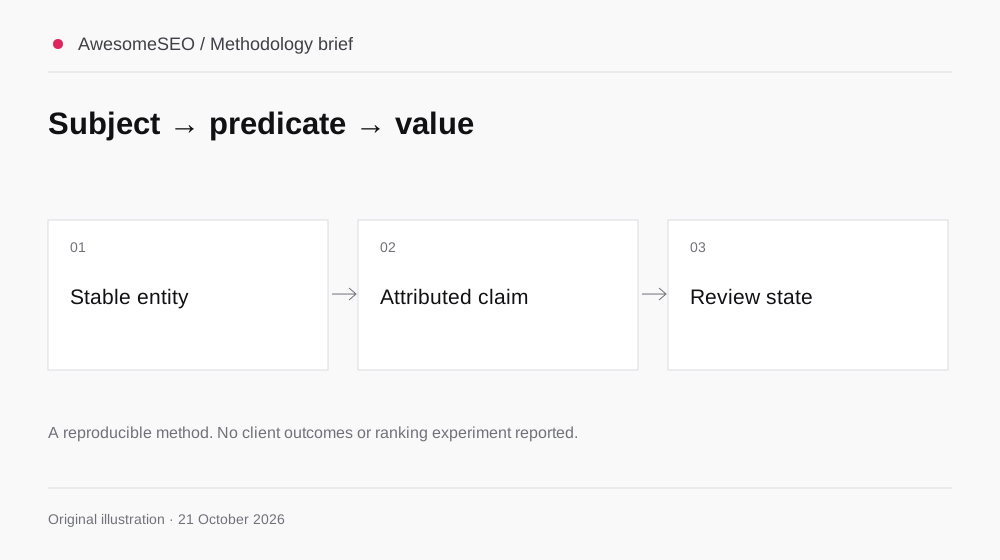
Separate an entity from a claim
Give an entity a stable internal identifier. A claim records a subject identifier, predicate, object value or entity identifier, source, observation time and review state. The same entity may have several names and identifiers; a label match alone does not prove that two records describe the same entity.
Keep entity–attribute–value and triples compatible
A literal attribute such as a legal name is a subject–predicate–literal statement. A relationship such as an organization owning a product is a subject–predicate–entity statement. Keep units, language, market and validity dates as qualifiers rather than hiding them in free text. Preserve conflicting statements for review rather than overwriting the older source silently.
Connect claims to page purpose
A product template needs product identity, offers and visible specifications. A brand page needs identity and supporting profiles. A guide needs attributable claims and relevant sources. Use the shared page-type registry to find the applicable template and enrichment checklist; do not put every available field on every page.
Make confidence explainable
The context screen measures the completeness of explicitly named profile fields. It does not measure factual truth, ranking likelihood or Knowledge Panel eligibility. A Google Knowledge Graph result score is a relevance value returned for that query, not a calibrated probability. Keep source agreement and human review state separate from field completeness.
How to use this source
An original methodology brief based on the repository’s current contracts. It reports no client outcomes or original ranking experiment.
Inspect the catalogue relationships
These triples describe editorial catalogue metadata. They do not verify the source’s conclusions.
- publishedBy
- AwesomeSEO
- about
- topic:semantic-triples
- about
- topic:entity-identity
- about
- topic:structured-data
- about
- topic:research
- appliesTo
- page-type:brand
- appliesTo
- page-type:glossary
- appliesTo
- page-type:product
- appliesTo
- page-type:category
- describesSource
- provider:google-knowledge-graph
- describesSource
- provider:wikidata
- describesSource
- provider:crossref
- describesSource
- provider:github
- cites
- resource:knowledge-graphs-survey
- cites
- resource:google-kg-api
- cites
- resource:wikidata-query
- cites
- resource:schema-org
Continue with related sources
Knowledge Graphs
A survey reference for graph models, knowledge construction and applications.
Reference · unreviewed claimsReading notes
Knowledge Graph Search API
Official entity lookup reference: identifiers, types, descriptions and result scores.
Reference · unreviewed claimsReading notes
Schema.org vocabulary
The vocabulary for describing entities, attributes and relationships in structured data.
Reference · unreviewed claimsReading notes
Wikidata Query Service
A public reference for querying identifiers and statements in Wikidata.
Reference · unreviewed claimsReading notes